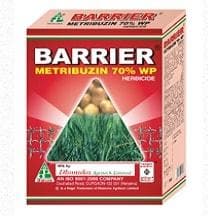
About Barrier Herbicide
Barrier Herbicide (Metribuzin 70% WP) by Dhanuka is a selective, dual-action herbicide that works through both root uptake and leaf absorption. Suitable for pre-emergence and early post-emergence application, it controls grasses, broadleaf weeds, and sedges in potato, tomato, soybean, wheat, and sugarcane. Dhanuka Barrier is a broad-spectrum solution for fields facing mixed weed infestation. It provides weed control with low-dose applications and no major residual effect on succeeding crops when used as recommended.
Barrier herbicide is a selective, systemic and contact in action and acts as both pre-emergence and post-emergence herbicide containing Metribuzin 70% WP as its active ingredient. It is used to control both grasses and broadleaf weeds in crops like potato, tomato, soybean, wheat and sugarcane.
It is commonly used as a broad-spectrum herbicide for potato, soybean and wheat fields where mixed weed infestation is a major problem.
Barrier Technical Name
Metribuzin 70% WP
Product Specifications
Mode of Entry: Systemic and contact
Time of Application: Pre-emergence and Early Post-emergence
Mode of Action: Barrier Herbicide inhibits photosynthesis at Photosystem II in weeds. It blocks electron transport during photosynthesis, stopping food production inside weed plants. This gradually leads to chlorosis, yellowing, and drying of weeds. It is absorbed mainly through roots and also through leaves, with movement inside the plant through the xylem.
Key Features & Benefits of Barrier Herbicide
- Dual-action herbicide that works through root uptake and leaf absorption.
- Useful against difficult weeds like Phalaris minor.
- Economical weed control with low-dose applications.
- No major residual effect on succeeding crops when used as recommended.
-
Effective on Weed Types: Broadleaf weeds, Grassy weeds, Sedges.
Barrier Herbicide Dosage & Recommended Crops
Crop |
Target Weeds |
Dosage/Acre |
Water Volume/Acre |
Dosage/Liter Water |
Waiting Period (Days) |
Soybean |
Cyperus campestris, Eragrostis spp., Digitaria spp., Cyperus esculentus, Borreria spp. |
200-300 g/acre |
300-400 L/acre |
0.66-0.75 ml/L |
30 |
Wheat |
Phalaris minor, Chenopodium album, Melilotus spp. |
100-120 g/acre |
200-300 L/acre |
0.4-0.5 ml/L |
120 |
Sugarcane (Pre-emergence) |
Cyperus rotundus, Cynodon dactylon, Asphodelus fistulosus, Chenopodium album, Convolvulus arvensis, Portulaca oleracea, Anagallis arvensis, Cichorium intybus, Echinochloa colonum, Dactyloctenium aegyptium, Parthenium hysterophorus, Commelina spp. |
60-80 g/acre |
300-400 L/acre |
0.2 ml/L |
60 |
Sugarcane (Post-emergence) |
Cyperus rotundus, Cynodon dactylon, Asphodelus fistulosus, Chenopodium album, Convolvulus arvensis, Portulaca oleracea, Anagallis arvensis, Cichorium intybus, Echinochloa colonum, Dactyloctenium aegyptium, Parthenium hysterophorus, Commelina spp. |
60-120 g/acre |
300-400 L/acre |
0.2 -0.3 ml/L |
60 |
Potato |
Chenopodium album, Trianthema monogyna, Parthenium hysterophorus, Fumaria parviflora, Melilotus spp., Phalaris minor |
300 g/acre |
300-400 L/acre |
0.75-1 ml/L |
30 |
Tomato |
Trianthema portulacastrum, Dactyloctenium aegyptium, Gynandropsis pentaphylla, Amaranthus viridis, Portulaca oleracea, Digera arvensis, Euphorbia frustrate, Echinochloa colonum, Ageratum conyzoides, Eleusine indica, Setaria glauca, Commelina benghalensis |
300 g/acre |
300-400 L/acre |
0.75-1 ml/L |
30 |
Method of Application
Apply Barrier Herbicide through ground spray using a knapsack or power sprayer fitted with a flat-fan nozzle for uniform soil and weed coverage.
Best Time to Spray
- Apply as a pre-emergence spray immediately after sowing or planting for best results.
- Early post-emergence application can also be done on young weeds.
- Soil moisture should be adequate during application.
- Avoid spraying during strong winds or heavy rainfall conditions.
- Sugarcane (Pre-emergence): Apply 3-5 days after planting
- Sugarcane (Post-emergence): Apply 25-30 days after planting
- Potato (Pre-emergence): Apply 3-4 days after planting
- Potato (Post-emergence): when plants have reached at a height of 5 cm
- Tomato (Pre-plantimng): Apply a week before transplanting
- Tomato (Post-plantimng): Apply 15 days after planting
Compatibility, Safety & Storage
Tank-Mix Compatibility
Consult an agronomist before mixing Barrier with insecticides, fungicides or fertilizers. Compatibility should be tested before large-scale tank mixing.
Safety Precautions
- Wear gloves, mask, full-sleeve clothing and safety goggles while spraying.
- Avoid spray drift to nearby sensitive crops.
- Do not eat, drink or smoke during application.
- Wash hands and exposed skin thoroughly after spraying.
- Keep out of reach of children, pets and livestock.
- Avoid direct contact with eyes, mouth and skin.
- Empty containers should not be reused.
- Dispose of used containers safely away from water bodies and habitation areas.
Storage
Store the herbicide in a cool, dry and well-ventilated place away from direct sunlight, food, feed and water sources. Keep in the original sealed container under lock and key.
Barrier Expert Advice
“Dhanuka Barrier is an excellent selective herbicide used to control both grasses and broadleaf weeds in crops like potato, tomato, soybean, wheat and sugarcane.” -BigHaat Agronomy Expert
Additional Information & State Restrictions
- Avoid spray overlap to prevent crop phytotoxicity.
- Use recommended dosage according to crop and soil type.
- Not to be used on crops other than specified on the label /leaflet
Disclaimer: This information is provided for reference purposes only. Always follow the recommended application guidelines outlined on the product label and accompanying leaflet.