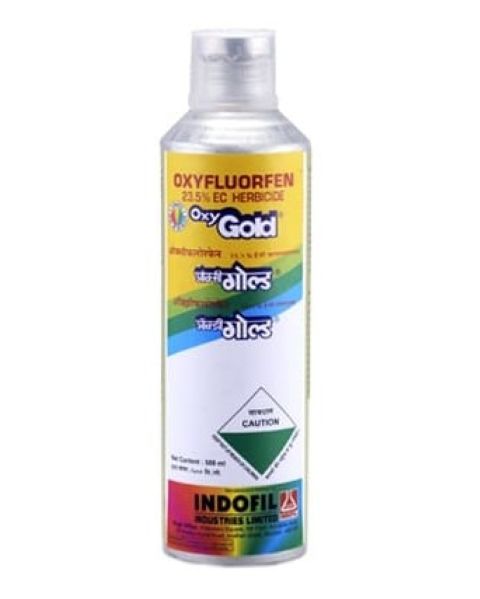
About OXYGOLD Herbicide
Oxygold is a diphenyl ether group herbicide containing Oxyfluorfen 23.5% EC as the active ingredient, used for pre-emergence and early post-emergence control of weeds. Farmers use Oxygold to control broadleaf weeds, grasses, and sedges in crops such as rice, tea, and onion. Oxygold helps reduce weed competition during crop growth, allowing crops to establish better and utilize nutrients more efficiently.
Oxygold is mainly applied before weed emergence or during the early weed stage. It is commonly used in direct-sown rice, tea plantations, and onion fields for effective weed management.
OXYGOLD Technical Name
Oxyfluorfen 23.5% EC
Product Specifications
Mode of Entry: Contact action
Time of Application: Pre-emergence / Early post-emergence
Mode of Action: Oxygold works by inhibiting an enzyme required for chlorophyll formation and cell membrane stability in weeds. When weeds absorb Oxygold, toxic compounds accumulate inside plant tissues and damage cell membranes in the presence of sunlight. As a result, weeds show burning, drying, and death symptoms within a few days after germination or emergence.
Key Features & Benefits of Oxygold Herbicide
- Oxyfluorfen 23.5 EC controls weeds without harming recommended crops when used correctly.
- Effective against broadleaf weeds, grasses, and sedges.
- Provides early-stage weed suppression and reduces repeat weed growth.
- Supports better crop establishments.
- Suitable for use in rice, tea, and onion crops.
-
Effective on Weed Types: Broadleaf weeds, Sedges, Grassy weeds
Oxygold Herbicide Dosage & Recommended Crops
Crop |
Target Weeds |
Dosage / Acre |
Dilution in Water / Acre |
Waiting Period |
Rice (Direct Sown) |
Echinochloa spp., Cyperus iria, Eclipta alba |
260–400 ml/acre |
Approx. 200 L water |
NA |
Tea |
Digitaria, Imperata, Paspalum, Borreria hispida |
400 ml/acre |
200–300 L water |
15 days |
Onion |
Chenopodium, Amaranthus viridis |
170–340 ml/acre |
200–300 L water |
NA |
Method of Application
- Apply Oxygold herbicide through ground-level spraying. Use a hand-operated knapsack sprayer fitted with a flat-fan nozzle for uniform coverage.
- Tractor-mounted sprayers may also be used for large areas.
Best Time to Spray
- Apply Oxygold as a pre-emergence spray immediately after sowing or transplanting.
- Pre-emergence applications can be made within 0-3 days of transplanting or sowing. As an early post-emergence application can be made up to 2-3-leaf weed stage.
- Soil should have adequate moisture at the time of spraying.
- Spray during calm weather conditions to avoid drift.
- Avoid disturbing the soil after spraying, as it may reduce Oxygold effectiveness.
Compatibility, Safety & Storage
Tank-Mix Compatibility
- Consult an agronomist before tank-mixing Oxygold herbicide with other pesticides or fertilizers.
Safety Precautions
- Wear gloves, masks, full-sleeve clothing, and safety goggles while spraying Oxygold.
- Avoid spraying during windy conditions to prevent drift to neighbouring crops.
- Do not eat, drink, or smoke during application.
- Wash hands and face thoroughly with soap after spraying Oxygold.
Symptoms of Poisoning:
- Headache, Nausea, Skin irritation, Eye irritation
First Aid
- Wash contaminated skin immediately with soap and water.
- Flush eyes thoroughly with clean water if exposed.
Storage
Store Oxygold in a dry and well-ventilated place away from sunlight, food, feed, and water sources.
OXYGOLD Expert Advice
“Farmers prefer this herbicide for its excellent weed control performance, cost-effectiveness, and suitability for ground-level spraying in recommended crops, resulting in effective and economical weed management.” - BigHaat Agronomy Expert
Additional Information & State Restrictions
- Oxygold is intended for agricultural use only.
- Do not use Oxygold on crops other than those recommended on the product label.
- Oxygold containers should not be reused.
Disclaimer: This information is provided for reference purposes only. Always follow the recommended application guidelines mentioned on the Oxygold product label and accompanying leaflet.